CrashTwin: A Physics-Grounded Benchmark for Multi-Agent Dynamics in World Models

1Texas A&M University 2University of Minnesota 3Yale University 4University of Texas at Austin 5NVIDIA 6Stanford University

*Equal contribution

Benchmark Evaluation Leaderboard

Lower is better unless marked with an upward arrow.

Models Spatio-temporal Consistency Momentum & Energy Conservation World-dynamics Integrity
Ewarp Ediv Jp JH JE SID Dad
Open-Source Models
SkyReel-1.3B 0.0227 0.6103 0.9566 0.9628 0.9457 0.6660 0.3592
Wan 2.1-14B 0.0179 0.6320 0.8235 0.8494 0.7864 0.6760 0.3117
Wan 2.2-5B 0.0145 0.5959 0.8899 0.8975 0.8649 0.7254 0.3109
Cosmos-Predict2-2B 0.0240 0.6748 0.8890 0.8954 0.8590 0.6129 0.3462
Cosmos-Predict2-14B 0.0117 0.7180 0.6828 0.7629 0.6047 0.6737 0.3327
Proprietary Models
Google Veo 3.1 0.0097 0.6202 0.7743 0.8011 0.7460 0.7232 0.3075
Hailuo 2.3 0.0151 0.6143 0.7664 0.7812 0.7285 0.6203 0.2968
Seedance V1 Pro 0.0166 0.6130 0.7725 0.7837 0.7209 0.6007 0.3002

Abstract

Generative world models hold immense promise as scalable simulators for autonomous systems, particularly for synthesizing rare but safety-critical multi-agent interactions, such as vehicle collisions. However, current evaluation paradigms index heavily on visual fidelity and semantic alignment, leaving a critical blind spot: they cannot reliably quantify whether generated dynamics actually obey the fundamental physical laws required for reliable simulation. Assessing this physical plausibility is inherently difficult due to a lack of grounded metrics and the challenge of extracting metric-scale kinematics from uncalibrated video rollouts. To bridge this gap, we introduce CrashTwin, a physics-grounded evaluation framework designed to stress-test the physical trustworthiness of world models. CrashTwin couples a diverse dataset of 25K controllable synthetic and 12K in-the-wild collision sequences with a novel calibration-free reconstruction pipeline, enabling the recovery of 3D physical attributes directly from monocular generations. We propose a diagnostic suite that systematically evaluates three dimensions: spatio-temporal consistency, momentum and kinetic energy conservation, and world-dynamics integrity. Extensive benchmarking of state-of-the-art models reveals a crucial insight: high perceptual quality frequently masks severe physical violations during complex interactions. By quantitatively exposing these failure modes, CrashTwin provides a vital diagnostic tool for developing physically grounded world models capable of reliable real-world simulation.
Physical Failure Modes

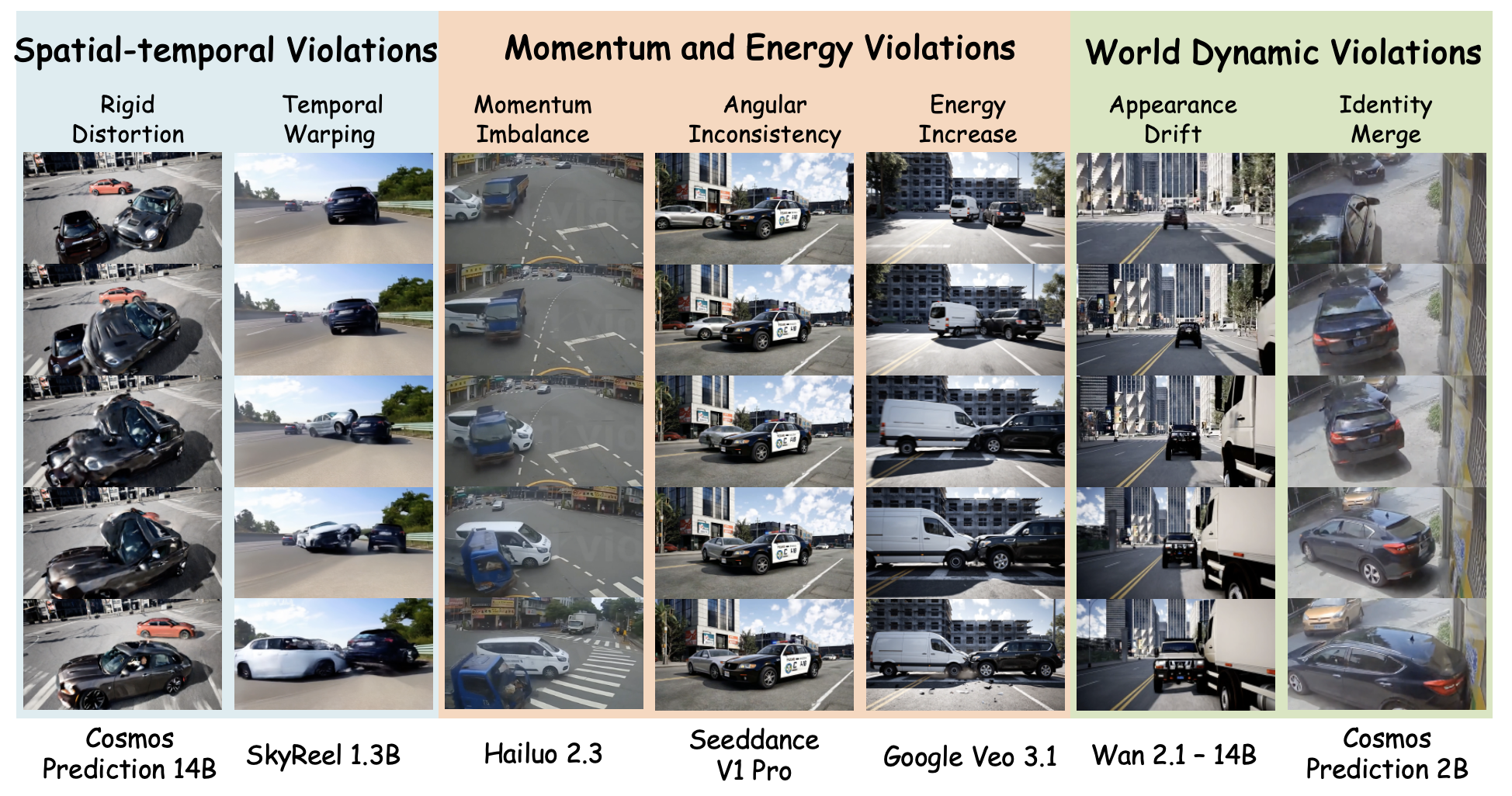
Representative spatio-temporal, momentum and energy, and world-dynamics violations observed across recent world models.

Representative physical violations across world models

CrashTwin Pipeline

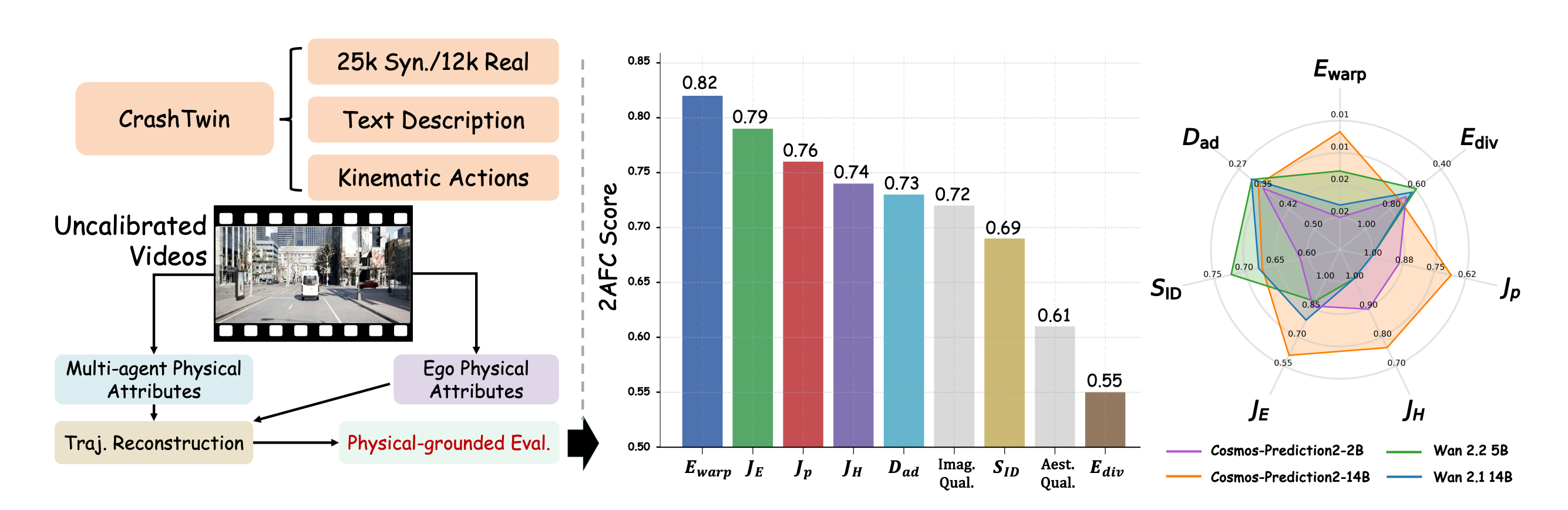
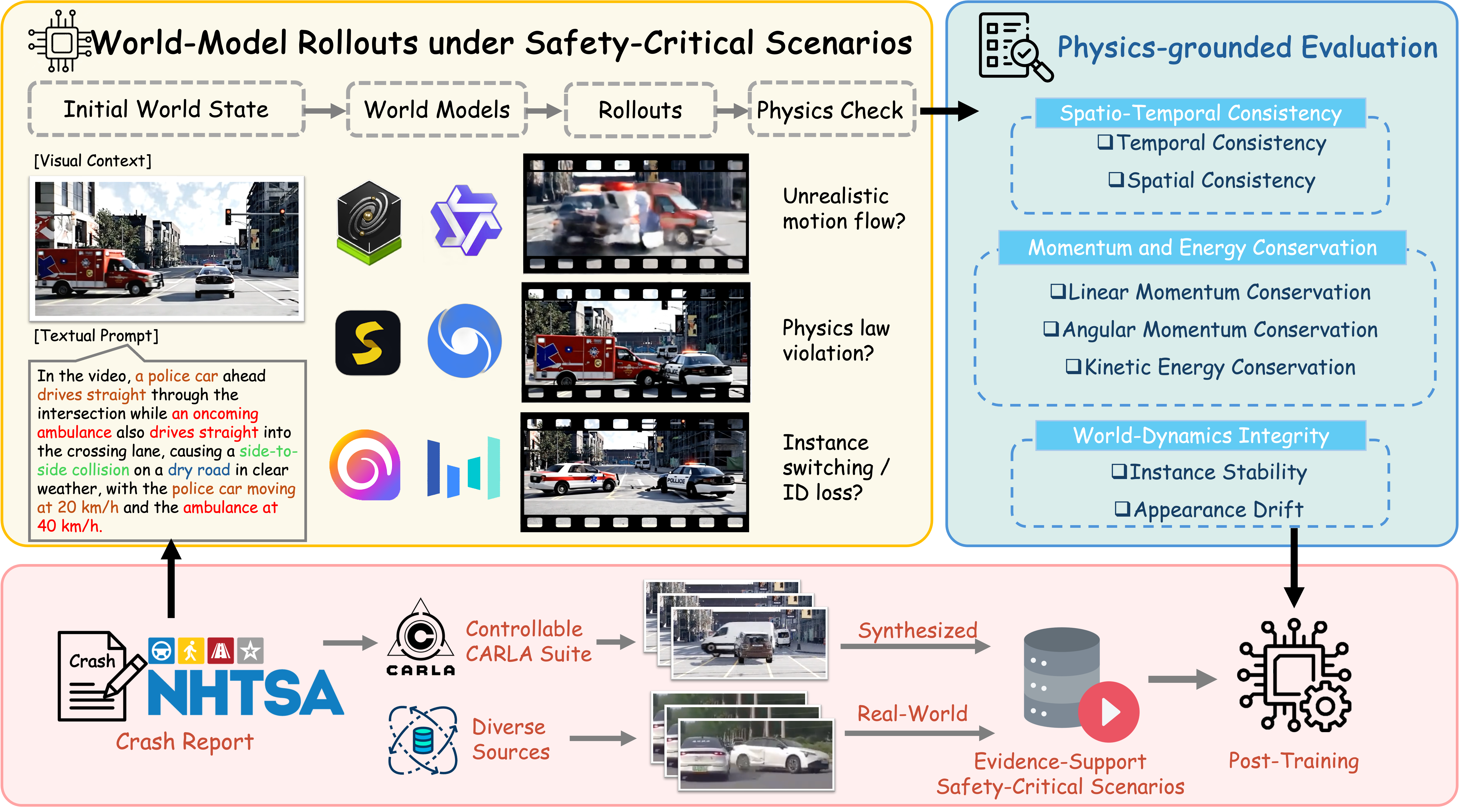
CrashTwin connects scenario design, monocular reconstruction, global dynamic recovery, and physics-grounded evaluation.

CrashTwin framework overview

CrashTwin Dataset

25.6K controllable synthetic crashes
12.6K in-the-wild accidents
3 diagnostic metric families
7 representative collision topologies

Physics-Grounded Metrics

Spatio-Temporal Consistency

Ewarp measures flow warping error for temporal coherence.

Ediv measures normalized flow divergence for near-rigid motion.

Momentum & Energy Conservation

Jp captures linear momentum residual.

JH captures angular momentum residual.

JE penalizes kinetic energy gain.

World-Dynamics Integrity

SID measures instance identity stability.

Dad measures appearance-drift distance.

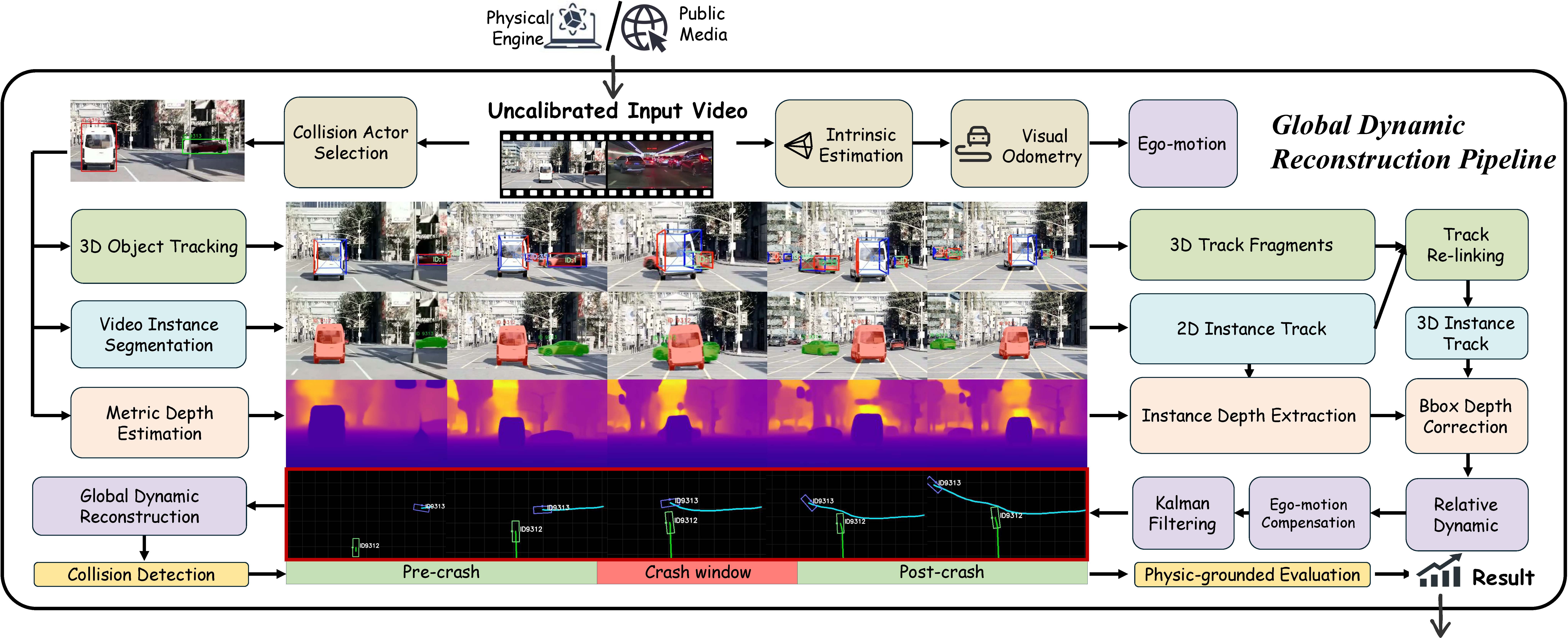
Global Dynamic Reconstruction

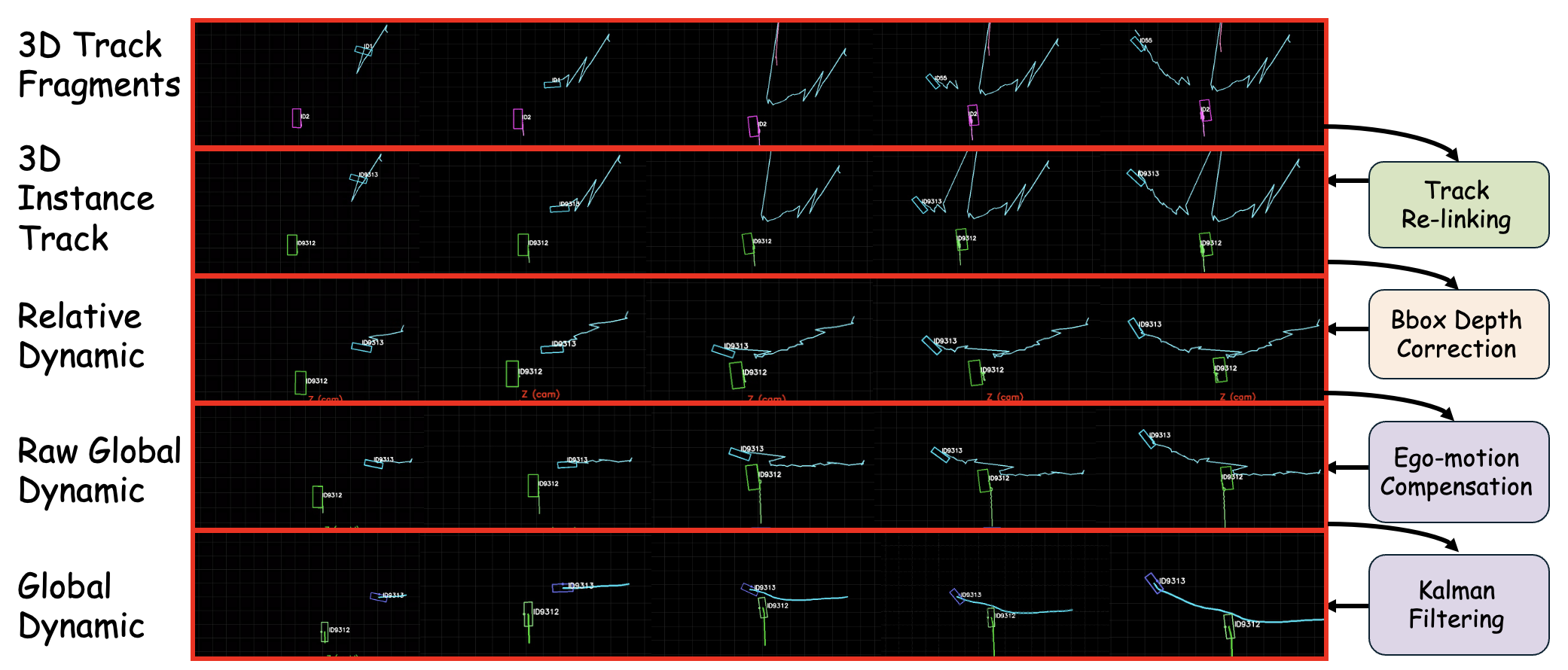
A calibration-free pipeline converts fragmented monocular tracks into globally consistent, metric-scale collision dynamics.

End-to-end evaluation pipeline from uncalibrated video to global dynamic reconstruction and physics metrics
Track refinement with relinking, depth correction, ego-motion compensation, and Kalman filtering

Metric-Human Alignment & Model Comparison

Physical metrics align with human judgments and expose substantial physical inconsistency across current world models.

Metric-human alignment and physics-based model comparison

Effect of Post-Training

Physics-oriented post-training improves all diagnostic metric families on Cosmos-Predict2-2B.

Model Variant Ewarp Ediv Jp JH JE SID Dad
Base (w/o post-training) 0.0240 0.6748 0.8890 0.8954 0.8590 0.6129 0.3462
Base (w/ post-training) 0.0085 0.6279 0.6479 0.7296 0.5534 0.7746 0.2953
Ground Truth 0.0075 0.6549 0.3089 0.4620 0.2502 0.8010 0.2819

Video Gallery

Rigid distortion Cosmos-Predict2-14B

Temporal warping SkyReel-1.3B

Momentum imbalance Hailuo 2.3

Angular inconsistency Seedance V1 Pro

Energy increase Google Veo 3.1

Appearance drift Wan 2.1-14B

Identity merge Cosmos-Predict2-2B

Reconstruction Case 1

Reconstruction Case 2

Reconstruction Case 3

Scene 1

Ground truth

Baseline

Post-trained

Scene 2

Ground truth

Baseline

Post-trained

Scene 3

Ground truth

Baseline

Post-trained